

Divorce Decree Modification Attorney
A divorce decree modification is a legal request asking the court to change part of an existing divorce order because circumstances have changed. In Illinois, this may include modifying child support, parenting time, custody, or spousal maintenance. Divorce decree modification attorney Denise Erlich helps clients request or defend modifications while protecting their rights and their children’s best interests.
Life Changes After Divorce. Your Court Order Should Change Too.
If your current divorce order no longer reflects your life or your child’s needs, you may be able to request a divorce decree modification in Illinois.
Life after divorce often brings new challenges, like job changes, remarriage, health concerns, relocation, or evolving needs for children. When those changes make an existing court order unfair or impractical, the law allows certain terms of your divorce decree to be modified.
Attorney Denise Erlich guides clients through the legal process of requesting or responding to a modification while protecting their rights and long-term interests.
Experienced Divorce Decree Modification Attorney Denise Erlich Can Help
A divorce decree modification may be necessary when there has been a substantial change in circumstances since your divorce was finalized. Illinois courts allow certain orders, such as child support, parenting time, custody, and spousal maintenance, to be modified when those changes make the original order no longer appropriate.
Because the court requires clear evidence and proper legal procedures, working with an experienced divorce modification attorney can help ensure your request is properly presented.
People seek divorce decree modifications when:
- A parent’s income or employment situation changes
- A child develops new educational, medical, or emotional needs
- One parent needs to relocate
- A parent is not complying with the current court order
- A parent remarries or experiences significant life changes
- A health condition or disability affects a parent’s ability to follow the original agreement
At Erlich Law, our family law attorneys evaluate your situation, explain whether a modification may be possible, and help you take the appropriate legal steps Our approach focuses on protecting your rights while working toward solutions that reflect your current reality and the best interests of your children.
Whether you need to modify child support, adjust parenting time, update custody arrangements, or enforce an existing court order, our firm can help you move forward with clarity and confidence
If your divorce order may need to be modified, start documenting the change in circumstances immediately. Keep pay stubs, medical bills, school records, or written communication that shows how circumstances have changed. Courts rely heavily on documentation when reviewing modification requests.

Call (630) 538-5331.
When Can a Divorce Decree Be Modified in Illinois?
A divorce decree in Illinois can only be modified when there has been a substantial change in circumstances since the original court order was entered. Courts require proof that the change affects the fairness or practicality of the existing order.
You generally cannot change a divorce order simply because it has become inconvenient or difficult to follow. However, if both former spouses agree to the proposed changes, they may submit a joint petition for modification, which the court may approve if it finds the agreement reasonable and consistent with the law.
Illinois courts evaluate these changes carefully before approving a modification. The person requesting the change must demonstrate why the existing order should be updated and provide evidence supporting the request.
Under Illinois law, courts generally will not modify an allocation of parental responsibilities (custody) within the first two years after the order is entered, unless the child’s physical or emotional well-being is at risk.
How to Modify a Divorce Decree in Illinois
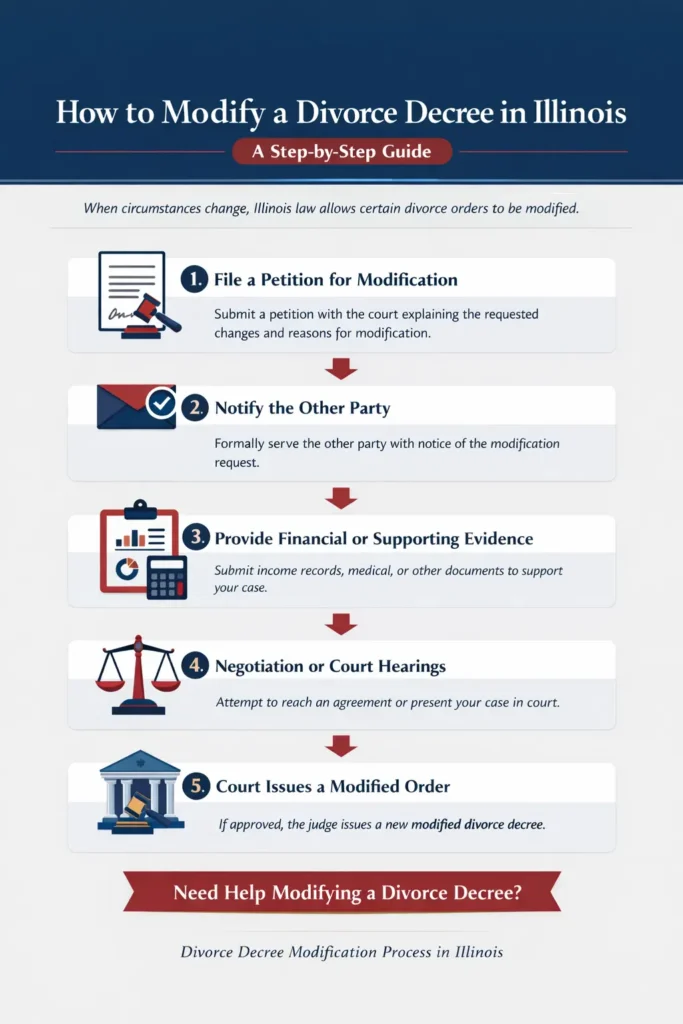
To modify a divorce decree in Illinois, you must file a petition for modification with the court and demonstrate that a substantial change in circumstances has occurred since the original order was entered. A judge must review the request and approve changes before they become legally enforceable.
File a Petition for Modification
The process begins when one party files a petition or motion for modification with the court that issued the original divorce decree. This document explains the requested changes and the reasons the modification is necessary.
Notify the Other Party
After the petition is filed, the other party must be formally served with notice of the request. This gives them the opportunity to respond, agree to the proposed changes, or contest the modification in court.
Exchange Information and Evidence
Both parties may be required to provide financial records, employment information, or other documentation that supports or challenges the requested modification. Courts often rely on this information when evaluating whether a substantial change in circumstances has occurred.
Negotiation, Mediation, or Court Hearings
Some modification cases are resolved through negotiation or mediation if both parties are able to reach an agreement. If an agreement cannot be reached, the court may schedule hearings where each side presents evidence and arguments.
Court Approval of the Modification
A judge will review the evidence and determine whether the requested change meets Illinois legal standards. If approved, the court will issue a new order modifying the original divorce decree. Until the judge signs the modified order, the original court order remains legally binding.
Working with an experienced divorce decree modification attorney can help ensure that your petition is properly prepared and that your interests are effectively represented throughout the process.
Even if your circumstances have changed, you must follow the existing court order until a judge approves a modification. Failing to comply can lead to penalties, including fines or enforcement actions.
Types of Divorce Decree Modification in Illinois
Common types of post-divorce modifications in Illinois include changes to parental responsibilities, parenting time schedules, child support obligations, and spousal maintenance.
Child Custody (Parental Responsibilities) Modifications
In Illinois, modifications to parental responsibilities (formerly called child custody) must serve the best interests of the child.
Under Illinois law, courts generally will not modify an allocation of parental responsibilities within two years of the original order unless there is evidence that the child’s current environment seriously endangers their physical, mental, or emotional health. After the two-year period has passed, a court may approve a modification if:
- Both parents agree to the change, or
- A substantial change in circumstances makes modification necessary to protect the child’s best interests.
Parenting Time Modifications
Parenting time schedules may be modified when changes in living arrangements, work schedules, or a parent’s location make the existing schedule impractical. For example, parenting time may need to be modified if:
- A parent relocates to another city or state
- A parent’s work schedule changes
- The child’s school, medical, or extracurricular needs change
In these situations, the court may approve a revised parenting time schedule that better supports the child’s stability and well-being.
Child Support Modifications
Child support orders may be modified when there has been a significant change in either parent’s income or in the child’s financial needs. Common reasons for child support modification include:
- A parent loses a job or experiences a major income increase
- The child develops new educational or medical expenses
- The child’s living arrangements change
Illinois courts evaluate updated financial information and apply the state’s child support guidelines when determining whether the support amount should be increased or decreased.
Spousal Maintenance (Alimony) Modifications
Spousal maintenance, also known as alimony, may be modified if the financial circumstances of either spouse change substantially. A modification may be appropriate when:
- The paying spouse experiences a major change in income
- The receiving spouse’s financial needs change
- The recipient remarries or begins cohabitating
- Either party’s earning capacity significantly increases or decreases
The court will review the circumstances of the case to determine whether adjusting the maintenance order is fair and appropriate.
If your circumstances have changed and your divorce order should be updated, attorney Denise Erlich can help you understand your legal options.

Call today
Enforcing Child Support Orders Post-Divorce
When the court orders child support, many parents willingly uphold their financial obligations. However, the loss of a job, a prolonged illness or injury, or other factors sometimes cause them to fall behind on their payments. Unfortunately, some parents simply refuse to pay. If a parent falls into arrears, the State’s Department of Healthcare and Family Services (HFS) has several child support enforcement options to recover past due balances.
Administrative Actions
HFS may take various administrative steps to bring past due child support balances current. These include requesting driver’s, professional, and recreational license suspensions.
Financial Actions
In addition to the administrative options, HFS also has financial enforcement actions it can take when people owe back child support. The department may intercept funds, such as state or federal tax refunds; place liens on certain property or financial accounts; and report the past due balances to the credit reporting agencies.
Failure to pay court-ordered child support can result in license suspension, wage garnishment, tax refund interception, and other enforcement actions.


“Denise was everything that we were looking for in a lawyer. She was open and honest with us about how she believed the case would go and helped us work through an uphill custody battle. She was both professional and personable. She answered all of our questions, provided solid counsel, and was very timely with getting back to us. We have used her for several occasions and are extremely satisfied with her work and commitment to helping our family. If you are looking for representation, I would wholeheartedly recommend her and her team for your needs.”

Minimizing Conflict and Stress For DuPage County Families
DuPage County post-decree enforcement and modification attorney Denise Erlich recognizes that when life changes, your needs, and the needs of your children, are often impacted as well. Serving as an advocate for you and your family, Denise will guide you through the divorce decree modification process and negotiate on your behalf.
FAQs About Modifying a Divorce Decree in Illinois
Can a divorce decree be modified in Illinois?
Illinois courts allow parts of a divorce decree, such as child support, parenting time, parental responsibilities, and spousal maintenance, to be modified when a substantial change in circumstances occurs. A petition must be filed with the court, and a judge must approve the modification before changes become legally enforceable.
What qualifies as a substantial change in circumstances in Illinois?
A substantial change in circumstances generally involves significant life changes that affect the fairness or practicality of the existing order. Examples may include a major change in income, a parent relocating, changes in a child’s needs, serious health issues, or other developments that impact parenting time, support obligations, or financial stability.
How long does it take to modify a divorce decree in Illinois?
The timeline for a divorce decree modification varies depending on the complexity of the case and whether both parties agree to the changes. Some uncontested modifications may be resolved in a few months, while contested cases requiring hearings or mediation may take longer.
Can child support be modified after a divorce in Illinois?
Child support orders may be modified if there has been a significant change in either parent’s income or in the child’s financial needs. Illinois courts review updated financial information and apply state child support guidelines to determine whether the support obligation should be increased or decreased.
What happens if my ex does not follow the divorce decree?
If a former spouse fails to follow the terms of a divorce decree, the other party may ask the court to enforce the order. Courts can impose penalties such as fines, wage garnishment, license suspensions, or other enforcement measures to ensure compliance with child support, parenting time, or other court-ordered obligations.
Can parents agree to modify a divorce decree without going to court?
Parents may reach an agreement regarding modifications, but the changes must still be approved by the court to become legally binding. Filing a joint petition for modification allows the court to review the agreement and issue a new order reflecting the updated terms.